Showing posts with label jennifer compton. Show all posts

Tuesday, October 13, 2015

Yawn by Sarah Rice


Funny how a yawn travels through a room
a pied piper gathering all the rats

In that instant we all draw from the same source
a great swallowed gasp shoved into our lungs

like socks stuffed in a bag
and the long outward sigh

That we try to hide it up our sleeves
makes us culprits in common

like playing truant
with a friend

It’s mostly like this
our bodies that bind us together

despite talk of mind’s united
mutual goals – a Weltanschauung

No, more likely it is that we all pee
bare-footed in the night

with toenails that particular pale shade of shell
and a shadow pressed onto each heel

That at a certain point in the evening
we reel our shoulders in on tiny strings

to catch the small warmth of our elbows
and shrink our silhouette

We all lean the same way as the bus turns a corner
grow a wide-legged stance on a train moving

We all rise
on tip-toe

at the edge
of cold water

And sneezing scares us somewhat
those first few seconds when the breath comes in and in with no end

We know the mundane imperative of bowel
and the incredulity of a broken heart

Our bodies loosen in warmth or water
and we all leave hair on the pillow

We share in the first great O
our mouths make for milk at the start

And the milky grey our eyes
all turn at the end.

© Sarah Rice

Posted on The Tuesday Poem with permission.

Editor, Jennifer Compton

I wasn't aware of Sarah Rice or of her considerable mad skillz as a poet (amongst other things) until I went to the event celebrating the inaugural Ron Pretty Poetry Prize – and the minute I walked in the room and spotted her I went kind of wow! (At that stage I wasn't aware her poem Speaking bluntly had won.) But there was something about her aura that took my eye. And her witty bumblebee ensemble of yellow and black – not quite Iris Apfel, but on track – certainly took my eye. And then she read her poem (well she knew it off by heart) and again, quite something.
Ron chose her poem as the winner - "for the sustained brilliance of its imagery, for its unity, and for its imaginative insights into the nature of language." Since then I have read a lot more of her work and I plan to read a lot more before I am done. Her take on things, her eye, her sense of equilibrium,
her insight into the human condition, they are all very more-ish indeed.

Ian Gibbons, Sarah Rice in yellow and black, Ron Pretty, Anne M. Carson, Steve Armstrong.

Sarah Rice is a Canberra-based art-theory lecturer, visual artist and writer, who co-won the 2011 Gwen Harwood poetry prize, and won the 2014 Bruce Dawe poetry prize, amongst other awards. Her limited-edition, art-book of poetry Those Who Travel (Ampersand Duck, 2010), with prints by Patsy Payne, is held in the collection of the National Gallery of Australia. Her poetry has been published in numerous journals and anthologies, including Award Winning Australian Writing and Best Australian Poetry 2012. Yawn was short listed for the Montreal Poetry Prize.


Listen to Sarah read her poem.

This week's editor is Jennifer Compton who lives in Melbourne. She is a poet and playwright who also writes prose. Her most recent book is a verse novella Mr Clean & The Junkie published by Mākaro Press.

In addition to today's feature be sure to check out the wonderful poems featured by the other Tuesday Poets, using our blog roll to the left of this posting. 

Tuesday, September 1, 2015

The Topography Of Wellington, by Jennifer Compton


There is a darkness here: and also an itinerant rainbow
strolling like a twister with one lazy finger dipped in water.
There is a harbour: because of the rainbow there may be
a glory, like a saint's halo, which is an optical effect. Glory.

There are six kererū  in Orangi-Kaupapa Rd feeding on miro:
or pūriru, tawa, tairare. These birds are almost too indolent
to fly, the telephone wires zig-zag under their exiguous feet.
As they pause - in their top heavy survey of topography, let

us consider our understanding of living above. Above contains
below. Look up to the hills and sky, look down the way a river
runs. You are having it both ways now. The sun seeks you out.
In the deep of night before dawn the wind and the rain blow in.

Look down into this glittering city, high on your slippery hill and
shrug. Would they have called it View Rd if it didn't have a view?


© Jennifer Compton 

from This City, Otago University Press, 2011
Reproduced on The Tuesday Poem with permission

Editor: Helen Lowe

Last Friday, August 28, was New Zealand's National Poetry Day for 2015. So what better to feature, I thought, than a poem about New Zealand by an expatriate New Zealander who is also one of our own — the indefatigable Jennifer Compton.

In 2008, Jennifer was Writer In Residence at Wellington's Randall Cottage — and from first reading I was captivated by the accuracy with which she captures the interwoven physical and emotional landscape of Wellington:

"There is a darkness here" she tells us, accurately I feel, but:

"...also an itinerant rainbow"

Also accurate. The poem that unfolds from these lines plumbs the emotional depths of physical environment, and in so doing, Jennifer Compton joins the masters who have caught a cultural sense of the city in literature. The Topography Of Wellington is part of a lineage that includes Lawrence Durrel's Alexndria Quartet and Italo Calvino's Invisible Cities:

"...Above contains
below. Look up to the hills and sky, look down the way a river
runs..."

Yet the topography of this Wellington remains as instantly recognisable as Dickens' London, portrayed in the opening paragraphs of Bleak House, would have been to his contemporaries. We encounter Jennifer Compton's six kererū with the same delighted shock of the familiar, the sense of yes, this is not only real, but true:

"There are six kererū in Orangi-Kaupapa Rd feeding on miro:
or pūriru, tawa, tairare. These birds are almost too indolent
to fly ..."

The Topography Of Wellington, as is only right and proper for both poetry and literature, provides a nexus where the local encounters the universal, to the extent I feel confident a reader anywhere in the world could read of looking down:

"...into this glittering city, high on your slippery hill"

and have a sense of what the poet saw. 

Reading The Topography of Wellington I was also able to concur with Kathleen Grattan Award judge, Vincent O'Sullivan comment about This City as a collection: 

'It is a volume that sustains a questing, warmly sceptical mind's engagement with wherever it is, whatever it takes in, and carries the constant drive to say it right. This is a complete book of poetry, coherent, gathering its parts to arrive at a cast of mind, a distinctive voice, far more than simply adding one good poem to another.'

I hope reading The Topography of Wellington today will encourage you to seek out both This City and more poetry by Jennifer Compton.

-- Helen Lowe

Jennifer Compton was born in New Zealand in 1949 and now lives in Melbourne. She has won several Australian awards for poetry and This City won New Zealand's Kathleen Grattan Award in 2010. Her poem, Now You Shall Know, won the Newcastle Poetry Prize in 2013, and the collection of the same name was published last year in Australia (Five Islands Press), while her verse novella Mr Clean & The Junkie was published this year in New Zealand as part of the Hoopla series 2015 (Mākaro Press). 

To discover more about  Jennifer and her work, visit her on her blog: 

Stillcraic

.


Today's editor, Helen Lowe, is a novelist, poet and interviewer whose work has been published, broadcast and anthologized in New Zealand and internationally. Her first novel, Thornspell, was published to critical praise in 2008, and her second, The Heir of Night (The Wall Of Night Series, Book One) won the Gemmell Morningstar Award 2012. The sequel, The Gathering Of The Lost, was shortlisted for the Gemmell Legend Award in 2013. Helen's fourth novel, Daughter Of Blood, (The Wall Of Night Series, Book Three) is forthcoming in January 2016. She posts regularly on her Helen Lowe on Anything, Really blog and is also active on Twitter: @helenl0we

In addition to today's feature be sure to check out the wonderful poems featured by the other Tuesday Poets, using our blog roll to the left of this posting. 

Tuesday, August 11, 2015

Two short poems by Vincent O'Sullivan


Skol

A man I talked with in a bar in Berlin
once read poetry, he said, with passion, served
with distinction in an army he loathed. Beyond
which he said little. He drank Schnapps. He advised,
as we parted, to avoid epiphanies as I would gunfire.
His phrase for ordering a Schnapps was 'to dim the lights'.


The sentiment of goodly things

The birds are back at the feeder
now the air is warmer.
                                  They come and go
in a way reminding me of keys in old
typewriters, flitting up and there for a second,
gone as another arrives.
                                    I don't quite
catch at what it is they're typing,
something, one fancies, about enjoying
the fact of again and again.
                                           I hope that's
what they're writing. It must be,
the way the keys keep coming back.


© Vincent O'Sullivan
Being Here: Selected Poems, Victoria University Press, 2015

Reproduced on The Tuesday Poem with permission.

Editor: Jennifer Compton

I was lucky enough to be in Wellington for the launch of this gorgeously attired, and stuffed-with-natural-goodness, book. It was a jolly fine night, fueled with excellent local wines and provender, and then me and my mate Coral, (Aussie mate from WA, second day ever in NZ) walked back along Lambton Quay and came upon the statue representing Katherine Mansfield, that Vince had had a hand in selecting (I found out later at a luncheon in Dunedin), and I took her hand and Coral took a blurry pic. Just one of those nights, you know. Well, when it came to the reading of the book, it had that same kind of well-fueled, insouciant, stroll-the-midnight-streets, head-spinning, I-think-I-finally-see-the-point-of-it-all, effect. And here comes a lucky convergence! Poetry can do that, and I think it should.
.
Vincent O’Sullivan is one of New Zealand’s leading writers, author of the biography of John Mulgan, Long Journey to the Border, the novels Let the River Stand and Believers to the Bright Coast, and many plays and collections of short stories and poems. He is joint editor of the five-volume Letters of Katherine Mansfield and has edited a number of major anthologies. He lives in Dunedin, and is the out-going NZ Poet Laureate.

To find out more, you may like to click here. 

Today's editor, Jennifer Compton, lives in Melbourne. Her poem, 'Now You Shall Know', won the Newcastle Poetry Prize in 2013, and the collection of the same name was published this year in Australia, while her long poem Mr Clean and The Junkie  was published in New Zealand as part of the Hoopla series 2015 (Mākaro Press). 

In addition to today's feature be sure to check out the wonderful poems featured by other Tuesday Poets, using our blog roll to the left of this posting.

Tuesday, August 4, 2015

"Tourist—Limerick" by Libby Hart

 .
The cry of a gull from God-knows-where
And the church bells
And the cars forever passing
And the girl screaming at the stopped car
And the horns tooting
And the girl saying: That’s crap, that is
And the little man in the passenger seat laughing his head off
And the lights of Paddy Power, all bright and shiny
And the smell of coal-smoke
And the cheap hotel room
where 1,000 other people have rested their sorry souls
And the broken tiles in the shower
And the chenille bedspreads
And the lace curtains that embrace the smell of cigarette smoke
And the red-emblazoned newsagent across the way
And the slick of the road as cars drive by like one endless engine
And the L-plate drivers who park their cars like dodgems
And the presence of a lack of presence
(and all that is left is desperation)

Here, a young girl scurries with a 12-pack of toilet rolls
against the roof of a pram

There, an old man sways in a gale all of his own making
.
©  Libby Hart
Published in This Floating World
Five Islands Press 2011
Reproduced on The Tuesday poem with permission.

Editor: Jennifer Compton
This lovely, fresh-faced, percipient book of poetry has done well for itself and it has caught the judge's eye three times. It's not a bit surprising because it is such a frisky yet elegant work, with an over-arching narrative that is elusive and seductive. Honestly it was like traveling around Ireland, clocking that, over-hearing this, breathing in the spirit of the place. And the craic is good. Libby lives in Melbourne and I bump into her from time to time, but somehow or other I have missed out on hearing her read. I must remedy that really soon.
Shortlisted for the Victorian Premier's Literary Awards
Shortlisted for the Age Book of the Year Awards
Longlisted for the Prime Minister's Literary Awards
.

Libby Hart’s first collection of poetry, Fresh News from the Arctic, received the Anne Elder Award and was shortlisted for the Mary Gilmore Prize. She is a recipient of an Australia Council for the Arts residency at the Tyrone Guthrie Centre at Annaghmakerrig in County Monaghan, Ireland and a DJ O’Hearn Memorial Fellowship at The Australian Centre, University of Melbourne. Her poem, ‘The Briefcase Phenomenon’ was chosen for the inaugural Poetry in Film Festival in 2010 and filmmakers produced short films inspired by it. In the same year This Floating World was devised for stage and performed by Teresa Bell and Gavin Blatchford. These performances received the Shelton Lea Award for Best Group Performance at the 9th Melbourne Overload Poetry Festival Awards.

To find out more, you may like to click on:

http://fiveislandspress.com/catalogue/this-floating-world

Today's editor, Jennifer Compton, lives in Melbourne. Five Islands Press published Now You Shall Know last year, and this year Mākaro Press published her verse novella Mr Clean & The Junkie.

In addition to today's feature be sure to check out the wonderful poems featured by the other Tuesday Poets, using our blog roll to the left of this posting.

Tuesday, March 3, 2015

A lyrebird by Michael Farrell


A lyrebird

Swift-footed it stops behind a mountain ash.
All genres are destroyed at last.
History, mistakes, swallowed up in a nominal grub.
The slow wild alcoholics of the nineteenth dare make no reply.
I tip my beak to the sky.
A nest-building lament starts up.
It's humans taking up too much room.
Swift-footed it stops behind a mountain ash.
The enclosed imagination buys a hunting gun.
All genres are destroyed at last.
Anthems say they love us too many times removed.
History, mistakes, swallowed up in a nominal grub.
Is this ground good ground?
The slow wild alcoholics of the nineteenth dare make no reply.
The tide's reach is projectile: look what lands in the bush.
I tip my beak to the sky.
Inside a person's mind the sandwich crack of axe, and moaning saw.
The nest-building lament starts up.
Somehow we're used by the earth's language.
A car rolled here like a sacked politician's speech.
Swift-footed it stops behind a mountain ash.
Cars learn ethics through becoming nests.
Like a camel that would take what's in my head!
All genres are destroyed at last.
A rhyme's a moral that becomes a fence; a fallen down fence is a joy forever.
The knitters are pulling the grass out by the roots.
History, mistakes, swallowed up in a nominal grub.
Patterns appear: I have no ears.
In the scanty shanty pleasure of meeting.
The slow wild alcoholics of the nineteenth dare make no reply.
The leaves full of memories of loves long lost, crumble and fade like ornaments.
Industry needs no commentary.
I tip my beak to the sky.


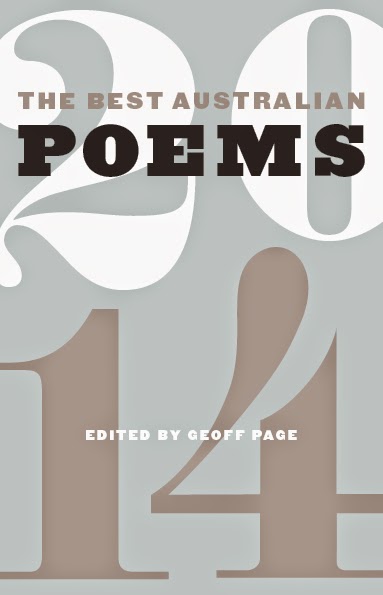
I came upon this poem in The Best Australian Poems of 2014. I always look forward to seeing what's happening with that series. But I have rarely been so gobsmacked as I was by this poem by Michael Farrell.
For a kick off, it is so modern! (and yet it looks back.)
And then it is so blatant with the way it throws the metaphor of poet as lyrebird into the air.
Next it toys with pantoum.
Fourth, it displays an intimate empathy with the male lyrebird (or an act of the imagination which is almost beyond imagining.)
(I could go on and on and on - but I won't, because the poem builds its own danceground and speaks for itself.)

Michael Farrell is the poet to watch here in Australia. His technical accomplishment leaves me weak at the knees. His cheek (which approaches chutzpah) is so very Australian. Again and again in recent years I have read poems of his that drive a stake into the red heart of Australia. He is a poet and a half!

Michael Farrel has lived and worked in Bombala, Canberra and Melbourne. 'A lyrebird' was written during a residency at the University of New South Wales, Canberra (ADFA) in 2013. His latest books and chapbooks are open sesame (Giramondo, 2012), same! same! same! same! (sus, 2014), and the thorn with the boy in its side (Oystercatcher, 2014).

Jennifer Compton lives in Melbourne and is a poet and playwright who also writes prose. Her most recent book is Now You Shall Know just out from Five Islands Press.