Showing posts with label Helen Rickerby. Show all posts

Tuesday, October 28, 2014

'No rough verses' from I, Clodia, by Anna Jackson


No rough verses, but like a surf‐tossed sailor
wielding wisely his gaff‐rigged fore‐and‐aft sail,
so shall I keep your favourite of Greek metres
to steer my way free of your storm of curses.
What I owe you – these claims you make are madness –
but to counter them one by one in order:
first, consider, what we owe Aphrodite –
your voyage here, as plunder of my husband,
your change of plans, your brother left unaided,
none of this can be laid as charges on me,
all was fated, and I merely received you.
Oh, I loved you, and being loved by me did
you not take more than you could ever give me?
Your ‘exile’ here – to live in Rome is living,
I don’t see you, in thrall to me no longer,
rushing back to your farmhouse in Verona, or
setting sail to do business in Bithynia.
Had you stayed put, a poet of the provinces,
not one person would know your name – or care to.


'No rough verses' is from Anna Jackson's about-to-be-published sixth collection of poetry, I, Clodia, and Other Portraits (Auckland University Press). More specifically, it's from the first section of that book, a long a sequence of poems - 'I, Clodia' - which takes as its subject and narrator one Clodia Metelli, an ancient Roman woman who was (almost certainly) the lover of the poet Catullus.

I didn't know much about Catullus or his poetry - which doesn't take away from the enjoyment of the sequence as far as I'm concerned (it contains everything you need to know to in the way of facts). But if you know anything much about Catullus, you'll know that he wrote a celebrated series of poems to his lover 'Lesbia' (Clodia), many of which were in reply to her poems. But his poems have survived, while hers (like a lot of women's history) are lost to us. One of the things Anna is doing in this ambitious work is to reconstruct the woman's side of this story, and to breathe life into the vibrant, quick-witted, not always likeable but rather admirable character of Clodia. As the AUP blurb says 'Jackson honours and subverts her source material in lines that are a marvel of ventriloquism.'

It was difficult to decide which poem from this sequence to share, partly because they are written to be read together. I chose this one because I think it can stand alone, but also because I'm really drawn to the strong rhythm, which I especially noticed in the first lines - don't you just feel like you're being tossed about by the waves, 'like a surf-tossed sailor'? Like several poems in this sequence that use tight forms and metre, this one is in hendecasyllables, which Anna tells me was one that the Romans adapted from the Greeks, and which was the form Catullus used most often. In English it isn't a flowing, natural rhythm, like iambic pentametre, which makes it well-suited to this boat lurching, to this proud, hurt narrator spitting out her bitterness at her lover, with whom she has such an up and down (and up and down) relationship.

Anna also let me know that this poem borrows from the play Medea, by Greek playwright Euripides, where Jason (of the golden fleece) tries to justify his abandonment of Medea (his wife, who had helped him nick the golden fleece). While not necessary to know, it adds another layer of richness to the poem. And these are really rich poems, which are just crying out for in-depth study.

I, Clodia fits with my strong interest in both narrative poetry and biographical poetry. The second half of this new collection continues with an interest in portraiture, but with shorter, more 'modern' poems, including some of my favourites of Anna's recent work, such as 'Sabina, and the chain of friendship' and the 'Pretty Photographer' poems. And some poems I haven't read yet, and which I'm rather excited about meeting.

For more Tuesday poems, check out the sidebar on the left.

Anna Jackson teaches English at Victoria University of Wellington. Her sixth collection of poetry, I, Clodia, and Other Portraits, will be launched in November. Two of her previous collections, Thicket (2011) and The Pastoral Kitchen (2001), were shortlisted for the New Zealand Book Awards. She has also published short fiction and academic books, and is part of the team (along with me) that is organising Truth or Beauty, Poetry and Biography - a conference about biographical poetry - in November.

This week's editor, Helen Rickerby, is a poet and publisher from Wellington. She has published four collections of poetry – her most recent, Cinema, was published by Mākaro Press in March. She runs Seraph Press, a boutique publishing company with a growing reputation for publishing high-quality poetry books, and she is co-managing editor of JAAM literary journal. She blogs irregularly at wingedink.blogspot.com and has a day job as a web editor.


Tuesday, September 23, 2014

'Poroporoaki to the Lord My God: weaving the Via Dolorosa' by Anahera Gildea


Ekphrasis in response to Walk (Series C) by Colin McCahon

I.      Bro, I noticed the absence of korowai at your tangi

II.     I have made you this kahu-kurī. A taonga
         for the Ngā Mōkai peoples and their descendants.
         I have just now taken it off the line and
         folded it with the sun still fresh on its limbs.

III.    The unsteady warps and welts of this cloak have caused
         the tāniko along the bottom to crack the horizon.
         But Muriwai nurtures the embers of our iwi, and this korowai will
         take on the spirits of every great leader and warrior who walks it.

IV.    The kahu-kurī were the war cloaks of chiefs.

V.     This sackcloth taonga will be your anchor now,
         (let go the weight of humanity on your black cross)
         it will cast threads from the living all the way
         to Manawatawhi – where you’ll take your last look.

VI.    And you will recognise that
         a black line separates the milk of the sky, sheepish and shrouded,
         from the knuckled gravel, where you took your first fall.
         It was expected, bro. No shame in trying to carry that tau alone,

VII.   no shame in taking direction – we are all sinners here.

VIII.  If you follow the next break in the horizon
         You may think it’s an invitation to walk out into the wet cold ocean
         and lose your breath underwater.
         It is not.

IX.    Instead look to where the sky has taken up tone
         long and arid, clouds formed from my fists,
         arguing with our tūpuna in there.
         They don’t want you to know

X.     that we do fall off; into the blackout, where the shade has been drawn.

XI.    Your ancestors and I worked that jute, brother,
         to get it to bleed like that
         with your open shores, your wounds unhealed:
         Te One Rangatira.

XII.   Here we both are, man,
         kneeling at the foot of all this white,
         at the beach broken by Christ already,
         facing the grief;

XIII.  I expect to see your tiny boat out there on the crooked horizon.

XIV.   Sometimes it is enough
         to sit and look out.
         Other times you have to walk
         across bone, stone and shell. 


Walk (Series C) in minature

I came across this poem while typesetting the 32nd issue of JAAM literary magazine, the contents of which have been selected by this issue's guest editor, Dunedin writer Sue Wootton. The loose theme of the issue is ‘Shorelines’, and the poems, stories, creative non-fiction pieces and photographs in the issue deal with that theme in a variety of literal and non-literal ways.

The cover of JAAM 32
Sue has selected many amazing pieces for JAAM 32, but this poem is the one that has struck me the most. When trying to explain to my partner what this poem was, and why I loved it, I got really emotional in ways I didn’t expect. Not only is this a powerful poem, but it is so interconnected with other powerful stories and powerful art by powerful artists. 

Standing on its own, it’s weaving the story of Christ – specifically the Stations of the Cross (also known as Via Dolorosa – the way of sorrows) – into a Māori cultural framework. It feels both contemporary and ancient, and as well as mixing times and places, it mixes between formal and informal language, and between English and Māori, just as it is weaving Western and Māori culture.

But this poem is also enriched by other powerful connections. As the subtitle says, iIt is an ekphrasis (a work of art in response to another work of art) in response to a series of paintings by Colin McCahon: Walk (series C), 1973. Colin McCahon is justly, in my opinion, one of New Zealand’s most celebrated artists. I can understand why people might not like his work – it isn’t ‘pretty’ and it moved further into abstraction throughout his career, but it never strayed from meaning. 

I first remember coming across his work at university. One of his giant ‘I AM’ paintings (Gate III, 1970) used to hang in the foyer to one of the lecture theatre blocks I frequented ( it’s since been moved downtown to Rutherford House). Part of its power is in its size – it’s enormous! I never fail to feel something every time I see it. (As a wee aside, I don’t think I quite appreciated it at the time, but the university art collection, which they hang around the campus, are amazing. You get an education in New Zealand art history just by wandering around, just by living with them.) 

So, for me, a reference to a McCahon painting is going to give a poem a bit of added feeling. Especially this work, Walk (Series C), which I had recently come upon in a piece I was editing about New Zealand painting for Te Ara (my day job). I suggest you go and have a look at a reproduction of this painting over here on Te Papa’s website: http://collections.tepapa.govt.nz/object/657795. Make sure you zoom in on the painting, so you can see each section. On one level, it’s a series of fairly abstract depictions of a beach – Muriwai, on Auckland’s wild west coast (also the setting for Gildea’s poem). Slightly deeper, it’s referencing the Stations of the Cross (as is Gildea’s poem). But yet another layer to Walk (Series C) is that it’s also about poet James K. Baxter, who had died the year befor McCahon painted this work. The two had been friends but had fallen out or become estranged. Both were Pākehā, but they shared an interest in Māori and Māori culture

The Te Papa website describes the painting as follows:

In Walk (Series C) McCahon journeys along Muriwai Beach in dialogue with his friend, perhaps recounting the shared events of their lives, perhaps seeking reconciliation. This walk runs parallel to another: in Maori belief, the spirits of the departed travel up the west coast towards Te Rerenga Wairua (Cape Reinga), from where they leap off the land to begin their final journey to the afterlife. As McCahon wrote to Peter McLeavey about the painting, ‘The Christian “walk” and the Maori “walk” have a lot in common.’ Drawing on personal and particular events in his own life, McCahon used them to address big themes in his art — themes of life and death, time and loss, Christian and Maori spirituality, history and place.

This connection with Baxter adds another layer of resonance to Gildea’s poem for me. Baxter’s poems, especially the later, rawer poems, are some of my most-loved poems. I am reminded of Baxter’s religious/political poem ‘The Māori Jesus’ which, like ‘Poroporoaki, brings Christ into the Māori world. And I feel there is something of the plain-speaking of Baxter’s later work. 

I’m by no means an expert in te reo – the Māori language – but for people reading this outside of New Zealand, and even some here, I thought a few translations might be helpful: A poroporoaki is a spoken farewell to the dead at a tangi (which is a funeral, but literally means to cry). A korowai is a cloak, and a kahu-kurī is a cloak made from the skin of a kurī – a Polynesian dog. Taonga means treasure. Nga Mōkai was what James K. Baxter called the people who came to live at his community at Jerusalem on the Whanganui River – he translated it as ‘the fatherless’. Tāniko are decorative woven borders on a cloak. Manawatāwhi is one of the Three Kings Islands, north-west of the tip of New Zealand. Tūpuna are ancestors. Te One Rangatira is another name for Muriwai, but literally means ‘the chiefly beach’, which is appropriate for a beach the Christ is walking on – or James K. Baxter for that matter, who in his own way was a leader for many.

When I sent a draft of this to Anahera, I wanted to her to check my definitions, particularly for tau, which I had translated as anchor – one of its meanings – because that echoed the first line in section V. I was on the right track, but I want to paraphrase and quote some of Anahera’s reply, because I think it gives beautiful insight into all the work that just one little word can do in poetry. All the layers and resonances that just a single three-letter word can have.

She said that in his paintings McCahon's often uses what is known as the Tau cross - that is the cross that looks like a capital T rather than a lower case t (as he does in Walk (Series C) to divide sections I and II). It is thought by some that Christ was crucified on a Tau cross, and it became an especially important symbol for Saint Francis and the Franciscans. You can read more about that here: http://www.thefranciscanfriars.org/taucross. She goes on to say:

The word also has meaning in Māori and I was using it to refer to the weight of an anchor and playing with the notion that it also means 'rest' – as in whakatau – which is a ceremony meaning to 'make calm'. I was taught that it originally specifically referred to the bringing in of the waka – and to make calm the sea – to bring it to rest.

There's so much more I could say about this poem, but I guess what I’ve basically been trying to say is that these layers on layers of things that mean something, especially to me, things which already have their own emotional and intellectual resonances, make Gildea’s already strong poem even stronger. And I’m really glad to have the opportunity, both here and with JAAM, to be involved in sharing it more widely.

Anahera Gildea
Anahera Gildea (Ngāti Raukawa-ki-te-Tonga) is a writer and mother who lives in Wellington. She is currently enrolled at the International Institute of Modern Letters at Victoria University and is working on her first novel.

This week’s Tuesday Poem editor is Helen Rickerby, a poet and publisher from Wellington. She has published four collections of poetry – her most recent, Cinema, was published by Mākaro Press in March. She runs Seraph Press, a boutique publishing company with a growing reputation for publishing high-quality poetry books, and she is co-managing editor of JAAM literary journal. She blogs irregularly at wingedink.blogspot.com and has a day job as a web editor.

And, now you're hopefully in the mood for more poetry. Good news! You can find more Tuesday Poems by clicking on the links in the sidebar.
 

Monday, April 7, 2014

Symbols that make up the breaking girl by Helen Rickerby

First comes feet, on tippy tippy
toe — a stretching, a reaching
for approval, perfection, a cracking
a creaking, a split and a snap, but nothing
that a good length of tape and some newly broken
in shoes can’t fix, shoes with the insides torn
out like an inquisition, then beaten and slashed
little dancers, little digits, they carry her away


The next, a cliché, but an oldy and a goody, because
she has to see her self, her reflection, to know
that she is real, that she exists, to give her something
to examine, to correct; her mother is

a mirror, her mirror is her mother, and what
have they to say to each other?
good girl, sweet girl, look what I have given
and given and given, just like me only this time better
a double, a dark doppelgänger who moves

just out of synch, just out of time, who will not
be tied down, who is flying up
right into her face, looking in the glass
a mirrored triptych, this one multi-faceted, this one
has fallen down and smashed to pieces, fragments
everywhere, splitting apart

The hallways are labyrinthine
she is Ariadne, Theseus, she is the minotaur
and the walls are closing in, sucking out all the air
in the apartment, where there is no living
room, at the school, where there is no resting
place, no cosy chairs, no comfort, only corridors
to wait in, floors to sit on, concrete and stairways to carry

her between heaven and hell, hell and heaven

A door can mean privacy, or entrance: a way in, a way
out, a way inside; a bathroom means
a closed door, a sanctuary, asylum, no one
to watch but the mirror, a secret place, a hungry need
a shutting, a barring, a tunnel into the abyss, or

into the true self, or selves, or really are we all just
a collection of random strangers, who have barely
even met, who have nothing to say to each other
as they mingle awkwardly at that posh soirée, that dive of a bar


Nails must be clipped, fingers and toes, try to keep
insides from seeping out, leaping out, oozing
and pushing out, but she can’t, her skin is too thin
her stomach too tight and before she knows it
there’s blood everywhere, it’s always

her own, she’s tearing and scratching, cracking and
splitting, fingers and toes, these unravelling girls
with their Snow White mouths
can’t they keep themselves together?


Shoulders are places for cares to settle, places to carry
heavy objects or other people, but shoulders are places
for wings to grow, and wings mean freedom, mean
flying away from here, mean looking down from up high
and all the little people, little things, shrunk

to insignificance; but then, a clipping, a snapping
and a falling from great height, poor
sweet girl, she’s got no chance


In the first, and in the last, there is the dance
of joy, of control, she can’t let go
she can’t let loose, she can’t let
her hair flow out behind her as she spins

her dance of life, dance of death, dancing
her negotiations, avoidances, eludations
in the club, under strobe lights, dark
and light, black and white, where a dance
can never be perfect, but even here

she has her red shoes on, yes, it’s this old story
over again, because she won’t stop dancing
can’t stop dancing, as long as she has feet
as long as she has legs, as long as they will carry her 


Editor: Mary McCallum
posted here with permission of the poet


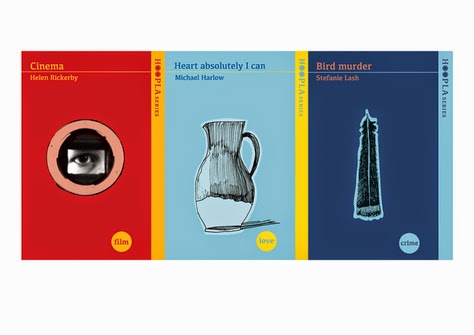
Cinema (Hoopla series, Mākaro Press 2014) is a book I'm very proud of and 'Symbols' is one of my favourites in the collection. I am Cinema's editor and publisher so I know the collection well - working with Helen Rickerby and Paul (the other part of our two-person publishing house) and designer Bill to create not just Helen's book but a whole new series called HOOPLA. (Designer Helen Reynolds created the fabulous eye-through-the-lens cover drawing for Helen's book.) 

HOOPLA is a dream I've had for a while - a series that leads readers to poetry because of the quality of the poets, the attraction of a series with three poets launching at once, the vivid and pocketable design, and the strong themes. 

Our 2014 release in this series is: 
Helen Rickerby's Cinema, Bird Murder – by first-time poet Stefanie Lash (theme: crime) – and Heart absolutely I can by established poet and Lauris Edmond Memorial Award-winner Michael Harlow (theme: love.) 

For the poets, I see the series as supportive and stimulating. For a publisher, it's a great idea because printing three poets at once leads to some useful cost savings and cross-overs in publicity.

As far as the support thing goes: Bookshops are often choosing to stock the set of three books rather than only taking one, which means if they want Michael Harlow because he just won the Lauris Edmond prize, Stefanie and Helen get a look in too (and good numbers :). Similarly, Helen and Stef attracted punters to our Pledgeme campaign to raise money to print Hoopla because they're more emersed in the social media/crowd-funding world than Michael is. Michael took info about Hoopla to a poetry event he attended in Nicaragua. The launch saw a range of poets and those who love poetry turning up to support the Hoopla threesome with supporters of one poet happily going off with a book by another poet, or the whole set... 
Hoopla High Tea with L-R publishers Paul Stewart & Mary McCallum,
poets Michael Harlow, Helen Rickerby & Stefanie Lash,
and PledgeMe supporter Ann Cunninghame. 
Back to Helen's poem 'Symbols that make up the breaking girl'. It is one of the poems where Helen lets loose - and how I love the way it sprawls and leaps and runs ... smart and rhythmic and contemporary, while linked to fairytale and the stuff of story. Best thing to do: read it aloud. Then read the whole book. 
Now forgive me for using the book blurb here but it does the job. 'The poems in Cinema look at the personal through the lens of the camera and the world of cinema through unfiltered eye. Meet the boy who learns to kiss from action movies, the girl made up of symbols and the direction with the aesthetic of the sniper on the roof.' 
Ah yes, that symbol girl – who can forget her! There is so much packed into Helen's book - as her launcher Anna Jackson said: 'It is like the tardis.' A very beautiful RED tardis which I just know will travel far.  Congrats to Helen, and to Stef and to Michael. And forgive me a publisher's indulgence here on Tuesday Poem. 


Helen Rickerby is a poet, editor and publisher who lives in Wellington. She has published 3.5 collections of poetry including Cinema which is available at all good bookstores and by emailing makaropress@gmail.com. She is co-managing editor of JAAM and runs boutique poetry publisher Seraph Press. 

Do check out the other poems in the sidebar - rich pickings. 

This week's editor is Mary McCallum – co-curator of Tuesday Poem, she is also a writer of fiction and poetry and has just published a children's novel with Gecko Press called Dappled Annie and the Tigrish. She is a publisher with Mākaro Press. 

Tuesday, March 4, 2014

From Bird Murder by Stefanie Lash

Tusk

Tusk was settled by rogue miners.
They went too far up-creek, there was no gold, they were lost.
They found instead the coloured stones.

The women are most industrious in tusk
and the children hop from house to house.
Perhaps because of the minerality of the River tusk

children’s hair will colour as they age.
Purple is the predominant hue; some boys turn green.
The huge prismatic slabs dominate industry:

tiling, tinted tonics prepared from the glacial flour,
some paper, an abundance of silkworms nearby.
From the terraced town the sea is very visible,

but visitors don’t come here. The jetty isn’t long enough
for pleasure boats and the blue mountains hug
and nest them so closely.


Passerine

I am sent to work on my impossible bottle.
I am sent to the train to board and alight, board and alight,
until a certain time has passed.

Swan fat for our faces is delivered in ice boxes.
On school days I count the windows of the manse
then count them again.

Wring, wring. Press my knees dry.
I must not look behind any statue.
I wear the whale in between each rib.

When I grow up I will learn to drive
and I’ll drive back and forth across the country
without ever needing petrol.

My name is Passerine and
I sigh into a man’s hat up in the attic.
J is for Juno, whispering down my telescope.


Iridescence

For feathers to iridesce
the molecular structure
is like a prism;

or air pockets retained in the feather
scatter light uniformly;
for feathers to be black,

melanin is present,
a strengthening agent.
But in the white feather – the white feather.

Pearls dissolved in vinegar.
Rinsed in the milk bath.
Only exposed to moonlight.

Have you seen a bird’s skull
aerially
like a droplet of bone frozen.


Posted with permission from Stefanie Lash and Mākaro Press. Soon to be published in Bird Murder.
Tuesday poem editor this week: Helen Rickerby

Stefanie Lash is a poet and archivist who lives in Aro Valley, Wellington. Her poems have appeared in journals including Sport, Takahē and Turbine. Bird Murder is her first book.


I couldn't resist. I know it's cheating, but it's Tuesday Poems this week rather than a Tuesday Poem because I couldn't resist sharing three of the poems from Bird Murder, Stefanie Lash's debut collection of poetry, which is going to be launched next week (details below). Bird Murder is one of the three books in the Hoopla poetry series, to be very soon published by Mākaro Press (along with Heart Absolutely I Can by Michael Harlow and my own collection, Cinema).

This is the official blurb for the book:
An albino huia, a stranger in the attic and a pink-haired woman ... Bird Murder is a gothic murder mystery telling of the demise of a ruined banker, set in the not-quite fictional town of Tusk.

At the heart of the story is the sacred bird, the huia: its beauty, curiosity and ‘fluted conversation’, and the consequences of its slaughter by early settlers.

As evening falls and Mr Cockatrice and his wife prepare for a party, questions surface. Are the gimlet-eyed creatures in the bird room capable of revenge? Is the stranger perching in the attic more than he seems? Or is the temptation of a fine head of cherry’d hair reason enough to murder?


I was lucky enough to get to get a pre-publication read of Bird Murder, and gosh it's good. I've never read anything quite like it. It's sort of a 'verse novel', as they call them in Australia, in that it tells a story over the course of the book, but it's so much more than that. The verse novels I've read have, it seems to me, sacrificed the poetry for the story, losing the richness of the language and ideas and layering of meaning. But that is so not true of the poems in Bird Murder, where the language is sparkly and playful, and so much is going on under the surface.

Although it is made up of poems in the same strict form - five stanzas of three lines each - there is such variety in this book. (Hence my desire to share more than one of the poems.) The styles and tones of the poems vary, and line lengths go from a single word to ones that stretch right across the page. The sum of the parts adds up to a unique collection that is by turns magical, grim, humorous, mysterious, strange and very satisfying.

It is also quite educational. You'll learn a lot about huia and other birds - along with the fiction there is a lot of fact, as evidenced by the notes and references at the end.

As I said, Bird Murder, along with Heart Absolutely I Can by Michael Harlow, and Cinema by me, is going to be launched next week, and you're invited. It's also a celebration of Mākaro Press's first year in the publishing business, and the end of Writers Week. So, Thursday 13 March (that's next week!), 5.30, Blondini's (the cafe at the Embassy Theatre), Wellington. Hope to see you there!


This week's editor, Helen Rickerby, has published two-and-a-half books of poetry, and her new collection, Cinema, will be published by Mākaro Press next week. She runs Seraph Press, a boutique publishing company with a growing reputation for publishing high-quality poetry books, and she is co-managing editor of JAAM literary journal. She blogs irregularly at wingedink.blogspot.com and has a day job as a web editor.

And do check out some of the other Tuesday Poems that you'll find in the sidebar to the left.

Tuesday, November 12, 2013

I hear you singing in the next room by Helen Rickerby

I hear you singing in the next room

It is more than not being alone

We cook together and eat
from      blue bowls

Sometimes I am the wise one
                         sometimes you

The night we met, we both
kissed the same boy

You write ‘I love you’ in the condensation
        on the window

I lead you into luxury and indolence

We walk to the zoo and promise the animals
                                                                freedom

We draw a magic circle around ourselves

It is more than not being alone, it is being together

I hear you singing in the next room


Posted with permission.
Editor: Janis Freegard


I love this poem, from Helen Rickerby's second collection, My Iron Spine.  You get a glimpse into a whole relationship through just a few well-chosen details. The poem has a sweetness and simplicity about it, but with sounds, colours and actions that make it come alive: the lover singing in the next room, the blue bowls, the trip to the zoo.  There is a real sense of two people wrapped up in each other, their love being greater than the sum of the individuals. 

There's a musicality about the poem too.  I especially like the line about "luxury and indolence".  I also like the way it circles back at the end, to the singing in the next room.  But this time, we hear the singing with a deeper understanding.


Helen Rickerby is the author of My Iron Spine (HeadworX, 2008), Abstract Internal Furniture (HeadworX, 2001), and the poem sequence Heading North, which was  published in a hand-bound hardback edition by Kilmog Press in 2010. She also runs the wonderful Seraph Press - a boutique publishing company with a growing reputation for publishing high-quality poetry books - and is co-managing editor of the literary magazine JAAM.

Helen's latest poetry collection, Cinema, will be published by Makaro Press early next year. She blogs irregularly at wingedink.blogspot.com.


This week's editor, Janis Freegard, is the author of the chapbook The Continuing Adventures of Alice Spider (Anomalous Press, US, 2013) and the collection Kingdom Animalia: the Escapades of Linnaeus (Auckland University Press, 2011), and is co-author of AUP New Poets 3 (Auckland University Press, 2008).  She lives in Wellington, New Zealand.


You can check out some of the other Tuesday poets and poems via the sidebar on the left.