Showing posts with label Mākaro Press. Show all posts

Tuesday, September 22, 2015

A letter to Jim Harrison by Lindsay Pope

.
It may be of no surprise to you that the day
your book arrived the waxeyes at my feeder
were noisier, more nervous and more abundant
than usual. On the global face, I live on the
lower cheek of the world where the tears fall
and turn to ice. So you might not know these
little birds. They may have hitched a ride on
some seafaring boat and decided to stay. Or
perhaps they caught the tail of some cross-
Tasman wind.

Your book flew in and has roosted in my head.
I have lost contact with my former Anglican
god and pray several hours most days in my
garden.

The plants are forgiving and do not object too
much to the muck I spread around, or
even when I rest to blow cigarette smoke about
their ears. The best time to talk with them is
when the light changes in the evening. The
warm soil seems to reassure as the chill of night
begins to settle on their leaves.

This land has no snakes, which makes us a
nation fearful of them. I am learning to live
with my own.

Thanks for your poems. I like digging into their
soil. It is like harvesting new potatoes. Each
time you unearth a shaw you do not know
what the reward will be.

As I write, the waxeyes are drinking. The wind
has turned to the south, so I’ll head down the
garden path to pick a supper of beans.

©  Lindsay Pope


Posted here with permission
Editor: Mary McCallum


Lindsay Pope
Lindsay Pope lives in Nelson, New Zealand. He keeps his head down digging the soil, chopping wood, picking his supper, hanging out with his family, writing poems. He writes of a life lived on the lower cheek of the world in the path of a bitter wind that can blow in from the south. Of men like himself living domestic lives in the path of that wind, making poems and planting potatoes to shore themselves up ... and other men living more rugged, isolated lives buffeted by the natural world ... all intent on leaving a mark somehow.

Jim Harrison
The keeper of uninhabited Stephens Island is the subject of 'Island Flight', and a coastwatcher during the war is the subject of 'Outpost'. The latter was posted by Keith Westwater on Tuesday Poem last year, and in a Landfall online review by Robert McLean, who said it was one of the best poems he'd read by a New Zealand poet for some time. He talks of this poet's 'bruised, stoical, masculine voice', praising his brevity, and the way he weighs every syllable, measures each phrase.

I know Lindsay's work well, having edited and published his first full collection Headwinds, which came out last year as part of our Mākaro Press Submarine poetry series, and includes 'A letter to Jim Harrison' along with 'Outpost' and 'Island Flight'.  Such riches.

'A letter ...'  is from one poet to another, and writes of the pleasure another man's words bring. It feels like a letter in its shape, the way the thoughts come – all at once to start with, and then line by line, thought by thought – and the voice is casual and colloquial, speaking as if to a friend. But there is also a glimpse of the heightened fabular language of a poet in the way Lindsay introduces himself and the place he calls home: those tears falling to ice, plants with ears. It is this combination that nabs me as a reader (and a publisher), and I admire the economical and confident way Lindsay achieves it.

What I love about this poem is also what it says to me about poetry per se: the way it (deliciously) roosts in the head as we go about our business, and how the reading of it pulls something gleaming and new from the dark soil of our brains.

Jim Harrison, I discover, is not unlike Lindsay in the life he leads and what he writes about. Jim lives on a farm in Michigan, and the Poetry Foundation talks of his connection to rural landscapes and the way 'he often explores human and animal drives set against an unforgiving world'. I didn't discover this about Jim when editing Lindsay's book, although I really should have. The author photos speak volumes! These two ought to hang out together.

This week's editor Mary McCallum is a poet, a novelist and a publisher who lives in Wellington, New Zealand. As a writer, she has published a chapbook of poems, a novel The Blue (Penguin 2007) and a children's novel Dappled Annie and the Tigrish (Gecko Press 2014).  Her Mākaro Press publishes poetry, fiction and creative non-fiction. She founded Tuesday Poem with Claire Beynon. 

In addition to today's feature be sure to check out the wonderful poems featured by the other Tuesday Poets, using our blog roll to the left of this posting. 

Tuesday, August 25, 2015

What Heartbreak Felt Like, by Annabel Hawkins


A full stop. In the middle of a sentence.
Not enough water in the jug for a cup of tea, and
all the milk's run out for good. Fumbling for your
keys in your bag at night. No-one remembered to
switch the light on before they went out.

That time you forgot your coat in a southerly,
called home and no-one was there. Just the hollow
sound of you waiting on the other end. But I've got
news, you thought. And your teeth closed together
with a clink.

The last drops in the bottle - leaving it upside
down, running out for too long and now it's
everywhere, all over the sink and through your
hands as you try to clear it away. The stainless
steel bench looks like it's bleeding. Great.

It's upstairs at a house quietly whispering down
the phone to the taxi man. Please come and take
me home now - I'll wait outside.
Waiting outside.
Waiting.

Weet-Bix in bed and another friend leaves to see
the world. Frozen-over cold on your car windscreen
on an August morning. You are as slow as the
engine as it shudders to warm up. Not having
enough money for a Memphis Meltdown.

Not being in the right shoes for the right party and
wondering if you even have a nice enough dress in
your wardrobe to wear anyway. Finally leaving for
the day, turning before you shut the front door.
The stony percolator no longer percolating

on the stovetop alone.

© Annabel Hawkins.
  
Published in This Must Be the Place, Mākaro Press, 2015

Thank you to Mākaro Press and Annabel Hawkins for permission to feature What Heartbreak Felt Like.

Editor: Janis Freegard

'What Heartbreak Felt Like' is from Annabel Hawkins' debut collection 'This Must Be the Place' one of the latest offerings from Mākaro Press. The collection is a collaboration between Annabel and   her friend, Alice, who designed the book.

Drawn from her blog, Spare Pencils and Scrap Paper, the book allows us a glimpse into a young woman's experiences in the city. Here you'll find thoughtful and readable contemplations on friendship, love and family, with a focus on how life changes - whether through moving house or saying goodbye. It's a collection filled with nostalgia for the recent past, in the way that nineteen seems so long ago when you reach twenty-three. In some ways it's like an assemblage of little stories - fragments of life captured between the leaves of a book like pressed flowers.

I like the way this poem evokes loss without dwelling on the cause of the heartache. We might not know exactly what happened, but we do know how it felt.

 
 Annabel Hawkins is based in Wellington, where she lives, leaves from, and returns to after her travels. She works in media and writes in all forms. While her talents know no bounds, her way with words often leaves others speechless.

Alice Clifford (the designer) lives in Wellington, travels frequently, and tutors design at Massey University. A member of the International Society of Typographic Designers and owner of a small library herself, words are at the forefront of her creative endeavours.


Today's editor, Janis Freegard, lives in Wellington, New Zealand. Her latest publications are a novel, The Year of Falling (Mākaro Press, 2015), and a poetry collection, The Glass Rooster (Auckland University Press, 2015).  She blogs at http://janisfreegard.com


You can check out more great poems featured by other Tuesday Poets, using our blog roll to the left of this posting.

Monday, April 7, 2014

Symbols that make up the breaking girl by Helen Rickerby

First comes feet, on tippy tippy
toe — a stretching, a reaching
for approval, perfection, a cracking
a creaking, a split and a snap, but nothing
that a good length of tape and some newly broken
in shoes can’t fix, shoes with the insides torn
out like an inquisition, then beaten and slashed
little dancers, little digits, they carry her away


The next, a cliché, but an oldy and a goody, because
she has to see her self, her reflection, to know
that she is real, that she exists, to give her something
to examine, to correct; her mother is

a mirror, her mirror is her mother, and what
have they to say to each other?
good girl, sweet girl, look what I have given
and given and given, just like me only this time better
a double, a dark doppelgänger who moves

just out of synch, just out of time, who will not
be tied down, who is flying up
right into her face, looking in the glass
a mirrored triptych, this one multi-faceted, this one
has fallen down and smashed to pieces, fragments
everywhere, splitting apart

The hallways are labyrinthine
she is Ariadne, Theseus, she is the minotaur
and the walls are closing in, sucking out all the air
in the apartment, where there is no living
room, at the school, where there is no resting
place, no cosy chairs, no comfort, only corridors
to wait in, floors to sit on, concrete and stairways to carry

her between heaven and hell, hell and heaven

A door can mean privacy, or entrance: a way in, a way
out, a way inside; a bathroom means
a closed door, a sanctuary, asylum, no one
to watch but the mirror, a secret place, a hungry need
a shutting, a barring, a tunnel into the abyss, or

into the true self, or selves, or really are we all just
a collection of random strangers, who have barely
even met, who have nothing to say to each other
as they mingle awkwardly at that posh soirée, that dive of a bar


Nails must be clipped, fingers and toes, try to keep
insides from seeping out, leaping out, oozing
and pushing out, but she can’t, her skin is too thin
her stomach too tight and before she knows it
there’s blood everywhere, it’s always

her own, she’s tearing and scratching, cracking and
splitting, fingers and toes, these unravelling girls
with their Snow White mouths
can’t they keep themselves together?


Shoulders are places for cares to settle, places to carry
heavy objects or other people, but shoulders are places
for wings to grow, and wings mean freedom, mean
flying away from here, mean looking down from up high
and all the little people, little things, shrunk

to insignificance; but then, a clipping, a snapping
and a falling from great height, poor
sweet girl, she’s got no chance


In the first, and in the last, there is the dance
of joy, of control, she can’t let go
she can’t let loose, she can’t let
her hair flow out behind her as she spins

her dance of life, dance of death, dancing
her negotiations, avoidances, eludations
in the club, under strobe lights, dark
and light, black and white, where a dance
can never be perfect, but even here

she has her red shoes on, yes, it’s this old story
over again, because she won’t stop dancing
can’t stop dancing, as long as she has feet
as long as she has legs, as long as they will carry her 


Editor: Mary McCallum
posted here with permission of the poet


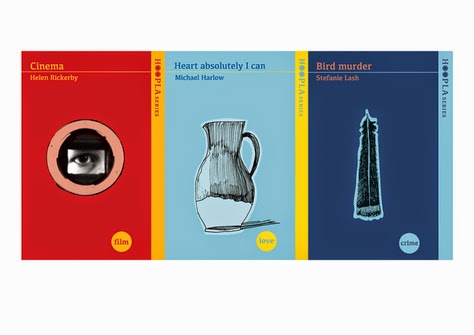
Cinema (Hoopla series, Mākaro Press 2014) is a book I'm very proud of and 'Symbols' is one of my favourites in the collection. I am Cinema's editor and publisher so I know the collection well - working with Helen Rickerby and Paul (the other part of our two-person publishing house) and designer Bill to create not just Helen's book but a whole new series called HOOPLA. (Designer Helen Reynolds created the fabulous eye-through-the-lens cover drawing for Helen's book.) 

HOOPLA is a dream I've had for a while - a series that leads readers to poetry because of the quality of the poets, the attraction of a series with three poets launching at once, the vivid and pocketable design, and the strong themes. 

Our 2014 release in this series is: 
Helen Rickerby's Cinema, Bird Murder – by first-time poet Stefanie Lash (theme: crime) – and Heart absolutely I can by established poet and Lauris Edmond Memorial Award-winner Michael Harlow (theme: love.) 

For the poets, I see the series as supportive and stimulating. For a publisher, it's a great idea because printing three poets at once leads to some useful cost savings and cross-overs in publicity.

As far as the support thing goes: Bookshops are often choosing to stock the set of three books rather than only taking one, which means if they want Michael Harlow because he just won the Lauris Edmond prize, Stefanie and Helen get a look in too (and good numbers :). Similarly, Helen and Stef attracted punters to our Pledgeme campaign to raise money to print Hoopla because they're more emersed in the social media/crowd-funding world than Michael is. Michael took info about Hoopla to a poetry event he attended in Nicaragua. The launch saw a range of poets and those who love poetry turning up to support the Hoopla threesome with supporters of one poet happily going off with a book by another poet, or the whole set... 
Hoopla High Tea with L-R publishers Paul Stewart & Mary McCallum,
poets Michael Harlow, Helen Rickerby & Stefanie Lash,
and PledgeMe supporter Ann Cunninghame. 
Back to Helen's poem 'Symbols that make up the breaking girl'. It is one of the poems where Helen lets loose - and how I love the way it sprawls and leaps and runs ... smart and rhythmic and contemporary, while linked to fairytale and the stuff of story. Best thing to do: read it aloud. Then read the whole book. 
Now forgive me for using the book blurb here but it does the job. 'The poems in Cinema look at the personal through the lens of the camera and the world of cinema through unfiltered eye. Meet the boy who learns to kiss from action movies, the girl made up of symbols and the direction with the aesthetic of the sniper on the roof.' 
Ah yes, that symbol girl – who can forget her! There is so much packed into Helen's book - as her launcher Anna Jackson said: 'It is like the tardis.' A very beautiful RED tardis which I just know will travel far.  Congrats to Helen, and to Stef and to Michael. And forgive me a publisher's indulgence here on Tuesday Poem. 


Helen Rickerby is a poet, editor and publisher who lives in Wellington. She has published 3.5 collections of poetry including Cinema which is available at all good bookstores and by emailing makaropress@gmail.com. She is co-managing editor of JAAM and runs boutique poetry publisher Seraph Press. 

Do check out the other poems in the sidebar - rich pickings. 

This week's editor is Mary McCallum – co-curator of Tuesday Poem, she is also a writer of fiction and poetry and has just published a children's novel with Gecko Press called Dappled Annie and the Tigrish. She is a publisher with Mākaro Press. 

Tuesday, March 4, 2014

From Bird Murder by Stefanie Lash

Tusk

Tusk was settled by rogue miners.
They went too far up-creek, there was no gold, they were lost.
They found instead the coloured stones.

The women are most industrious in tusk
and the children hop from house to house.
Perhaps because of the minerality of the River tusk

children’s hair will colour as they age.
Purple is the predominant hue; some boys turn green.
The huge prismatic slabs dominate industry:

tiling, tinted tonics prepared from the glacial flour,
some paper, an abundance of silkworms nearby.
From the terraced town the sea is very visible,

but visitors don’t come here. The jetty isn’t long enough
for pleasure boats and the blue mountains hug
and nest them so closely.


Passerine

I am sent to work on my impossible bottle.
I am sent to the train to board and alight, board and alight,
until a certain time has passed.

Swan fat for our faces is delivered in ice boxes.
On school days I count the windows of the manse
then count them again.

Wring, wring. Press my knees dry.
I must not look behind any statue.
I wear the whale in between each rib.

When I grow up I will learn to drive
and I’ll drive back and forth across the country
without ever needing petrol.

My name is Passerine and
I sigh into a man’s hat up in the attic.
J is for Juno, whispering down my telescope.


Iridescence

For feathers to iridesce
the molecular structure
is like a prism;

or air pockets retained in the feather
scatter light uniformly;
for feathers to be black,

melanin is present,
a strengthening agent.
But in the white feather – the white feather.

Pearls dissolved in vinegar.
Rinsed in the milk bath.
Only exposed to moonlight.

Have you seen a bird’s skull
aerially
like a droplet of bone frozen.


Posted with permission from Stefanie Lash and Mākaro Press. Soon to be published in Bird Murder.
Tuesday poem editor this week: Helen Rickerby

Stefanie Lash is a poet and archivist who lives in Aro Valley, Wellington. Her poems have appeared in journals including Sport, Takahē and Turbine. Bird Murder is her first book.


I couldn't resist. I know it's cheating, but it's Tuesday Poems this week rather than a Tuesday Poem because I couldn't resist sharing three of the poems from Bird Murder, Stefanie Lash's debut collection of poetry, which is going to be launched next week (details below). Bird Murder is one of the three books in the Hoopla poetry series, to be very soon published by Mākaro Press (along with Heart Absolutely I Can by Michael Harlow and my own collection, Cinema).

This is the official blurb for the book:
An albino huia, a stranger in the attic and a pink-haired woman ... Bird Murder is a gothic murder mystery telling of the demise of a ruined banker, set in the not-quite fictional town of Tusk.

At the heart of the story is the sacred bird, the huia: its beauty, curiosity and ‘fluted conversation’, and the consequences of its slaughter by early settlers.

As evening falls and Mr Cockatrice and his wife prepare for a party, questions surface. Are the gimlet-eyed creatures in the bird room capable of revenge? Is the stranger perching in the attic more than he seems? Or is the temptation of a fine head of cherry’d hair reason enough to murder?


I was lucky enough to get to get a pre-publication read of Bird Murder, and gosh it's good. I've never read anything quite like it. It's sort of a 'verse novel', as they call them in Australia, in that it tells a story over the course of the book, but it's so much more than that. The verse novels I've read have, it seems to me, sacrificed the poetry for the story, losing the richness of the language and ideas and layering of meaning. But that is so not true of the poems in Bird Murder, where the language is sparkly and playful, and so much is going on under the surface.

Although it is made up of poems in the same strict form - five stanzas of three lines each - there is such variety in this book. (Hence my desire to share more than one of the poems.) The styles and tones of the poems vary, and line lengths go from a single word to ones that stretch right across the page. The sum of the parts adds up to a unique collection that is by turns magical, grim, humorous, mysterious, strange and very satisfying.

It is also quite educational. You'll learn a lot about huia and other birds - along with the fiction there is a lot of fact, as evidenced by the notes and references at the end.

As I said, Bird Murder, along with Heart Absolutely I Can by Michael Harlow, and Cinema by me, is going to be launched next week, and you're invited. It's also a celebration of Mākaro Press's first year in the publishing business, and the end of Writers Week. So, Thursday 13 March (that's next week!), 5.30, Blondini's (the cafe at the Embassy Theatre), Wellington. Hope to see you there!


This week's editor, Helen Rickerby, has published two-and-a-half books of poetry, and her new collection, Cinema, will be published by Mākaro Press next week. She runs Seraph Press, a boutique publishing company with a growing reputation for publishing high-quality poetry books, and she is co-managing editor of JAAM literary journal. She blogs irregularly at wingedink.blogspot.com and has a day job as a web editor.

And do check out some of the other Tuesday Poems that you'll find in the sidebar to the left.

Tuesday, January 28, 2014

Eastbourne by Helen Jacobs

1
It is to the island
and the coastlands
that the shifting light
tethers on a fluid line
weaving water and sand
and rock.

The point of going away
is always to come back –
thrice deny, and you
come back

to the shells of your sandheaps,
allow that there could be
an old spirit or two
or simply an old love affair
with the harbour playing you in.


2

Climbing to the houses
you look down to where
yachts gather, to the path
of the ferries, to all
the usual traffic on the rim,
and you are caught in
the particular pattern
of this moment’s water movement,
this wind flurry, this shadow
darkening green to grey,
and you cannot leave it
because the evening will be
different, and tomorrow will be
different, and the sky has
so many ways of passing before
you, and you cannot gather
all this into imagination so
you must stay.


3

The wide open coast lends itself
to the wind, moods of high spray
over the scrub and frayed flax.
You walk here with your ears wool-
covered, hands in deep pockets,
crouch into a rock or low bush
with your sandwiches.

But on the days of endless blue
there are three white lighthouses
to choose from, the sea a slow swell,
a fishing boat sitting distant,
and you walk to one lighthouse or
the other over sand, clay, rock,
rhythm your steps to a remote clarity
that you can only paint –
or stare at;
in the stillness of the sun
count seven seals, or the houses
on the other shore, and take home one
fingernail-sized shell to code it all,
this question of where the heart lies.

1999
posted with the poet's permission


Editor: Mary McCallum 

Not long before Christmas last year, the people of Eastbourne (NZ) packed out local bookshop Rona Gallery to launch Eastbourne : an anthology (Mākaro Press). The woman launching the book was former mayor  Elaine Jakobsson who writes as poet Helen Jacobs. Her poems 'bookend' the 300 page book, and Elaine had flown north from Christchurch especially to be there. 

After Elaine's launch speech, there were readings from the book, but the last to read was Elaine herself, and Eastbourne is the poem she read. For all who live here it is a taonga — a gift — something to return to as much as the place itself — and the perfect ending to this book of place. 

I speak of Eastbourne with such warmth because I am the publisher at new press, Mākaro, and one of the editors along with Anne Manchester and Maggie Rainey-Smith. Helen Jacobs (now in her 80s) was one of our wonderful finds. The collection of writing — poetry, fiction and creative memoir by 96 different authors — and drawings by local artists, evoke Eastbourne of the imagination, taking readers into the place bay by bay, from Point Howard to Pencarrow. There is classic writing by writers like Katherine Mansfield and Robin Hyde, high profile contemporary writers like Steve Braunias and Lloyd Jones, and fresh new writing from talented locals and visitors like Avi Duckor-Jones and Sarah Laing. 

Elaine Jacobsson was born in Patea in 1929. She came to live in Lowry Bay in 1954, and stayed in  Eastbourne for 36 years. Following an involvement in community activities and environmental issues she was elected Mayor of Eastbourne in 1980, and appointed to the Planning Tribunal in 1986. Since 1984. she has published six collections of poetry, the most recent being DRIED FIGS (2012). 

Elaine/Helen's work has been published in many magazines and anthologies including ‘Yellow Pencils’ 1988, ‘Oxford Anthology of Love Poems’ 2000, ‘Essential NZ Poems’ 2001, ‘My Garden, My Paradise’ 2003, ‘This Earth’s deep Breathing’ 2007, ‘Our Own Kind’ 2009 and in numerous Canterbury anthologies. She retired to Christchurch in 1994 where she has been active in the poetry community and the Canterbury Poets Collective. Visit her at helenjacobspoetry.wordpress.com. 


What a pleasure it was meeting Elaine! And huge thanks to Robyn Cooper who looked after her so wonderfully when she came for the launch. 


One of the joys on working on Eastbourne for us editors was the joy of finding writers from the past life of the community we hadn't expected or known much about, and giving their work more time in the sun. Part of Elaine's speech at the launch of Eastbourne is worth recalling for its acknowledgement of this:


By casting the net generously to gather in retrospective writers as well as current, prose writers of every category as well as poets, this book will have a wide and lasting appeal, and will convey something of the complex nature of writers within the same environment, and something of their attachment to living here, something of the nurse bed of their inspiration. 
And it achieves more. In this age where all is floating in a cloud, dispersed in a sea of twitter, it brings together and gives anchorage to the writers — a tangible centring. 

This is our first post of 2014, at another place where writers and readers can be centred, and find anchorage. Do join us here at Tuesday Poem every Tuesday to meet another poet and poem. In the sidebar, 30 Tuesday Poets post a Tuesday Poem of their own each week — either by themselves or a poet they admire. Check it out.